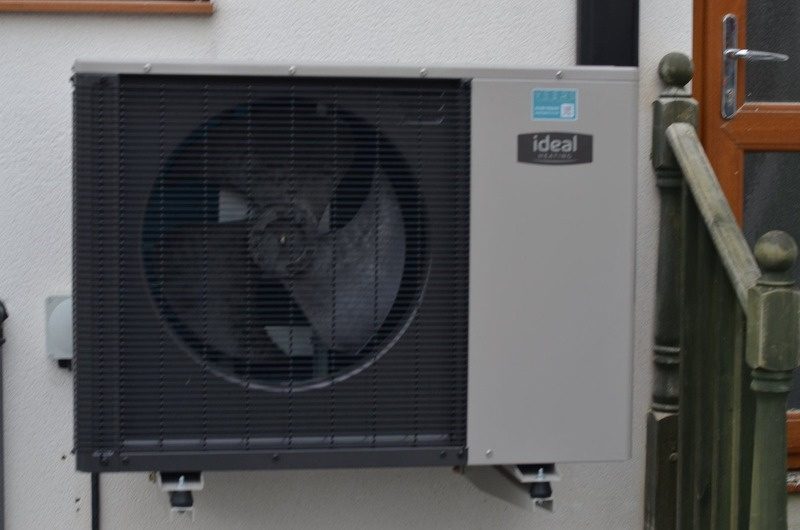
As heat pumps become more common in the UK, so does the amount of misinformation surrounding them. It's become enough of a problem that the UK Government has hired the Behavioural Insights Team specifically to tackle the spread of heat pump myths in the media. Energy Saving Trust's energy experts have gone through the most common claims and checked them against the evidence. Here's what's actually true.
Myth: Heat pumps are noisy
Heat pumps typically run at between 40 and 60 decibels, which puts them in the same range as a fridge or a gas boiler. Acoustic experts who investigated heat pump noise found them to be about as loud as a refrigerator. Installations also have to meet strict standards — in most cases, a heat pump can't be installed unless the noise level is 42dB or less when measured a metre from a neighbour's window, or planning permission is required.
Heat pumps can get a little louder during cold snaps, when they're working harder, but even then you should be able to hold a normal conversation standing right next to one. If a heat pump is noisier than expected, it's usually a sign it needs servicing or wasn't levelled correctly during installation — and anti-vibration feet, similar to those used for washing machines, are available if needed.
Myth: Heat pumps cost more to run than a gas boiler
At current energy prices, running a heat pump costs roughly the same as running a new gas boiler. If you switch to a heat-pump-friendly time-of-use tariff, you could save money over a standard tariff. And if you're replacing an older, less efficient boiler, a heat pump will typically be cheaper to run — beating any other heating system on running costs.
The underlying efficiency case is strong: heat pumps are around four times as efficient as a new gas boiler, meaning they extract far more heating power per unit of energy used. The reason this hasn't yet translated into a clear-cut cost advantage for everyone is that electricity is currently around four times as expensive as gas in the UK, and the UK has the highest electricity costs in Europe. Once that imbalance between gas and electricity pricing narrows, heat pumps are expected to become the cheapest way to heat a home.
Myth: Heat pumps don't work in cold weather
They do — although efficiency drops somewhat as the temperature falls. Most current heat pump models work fine down to around -25°C, and some advanced cold-climate models operate as low as -35°C. This is possible because even cold outside air contains usable energy; it simply takes more electricity to extract it. Many systems also include backup electric resistance heating for the coldest days.
The clearest evidence against the "too cold for the UK" argument comes from Scandinavia. Norway has an average temperature of almost -7°C and stays below freezing for most of winter, yet around two-thirds of Norwegian homes have a heat pump. In fact, the top four countries in Europe for heat pump ownership — Norway, Sweden, Finland and Estonia — are among the continent's coldest. By comparison, the UK's average winter temperature in 2024 was over 5°C, making the claim that heat pumps can't cope with British winters hard to sustain.
Myth: You must fit new radiators
Not necessarily — but bigger radiators can significantly improve how well a heat pump heats a home. "Bigger" here means more surface area, not necessarily more wall space, so a switch to a double or triple panel radiator can do the job. Larger radiators let the system run at a lower water flow temperature, and the lower that flow temperature, the more efficient — and cheaper to run — the heat pump becomes. Replacing a double panel radiator costs around £200 on average, and a good installer will flag whether they recommend upgraded radiators as part of your quote.
Myth: Your home needs to be fully insulated first
A heat pump can be installed and run effectively without a home being fully insulated. Insulation reduces heat loss and lowers running costs for any heating system, but it isn't a strict precondition for a heat pump specifically.
It's true that part of the reason heat pumps have thrived elsewhere in Europe is that homes there tend to be better insulated — UK homes lose heat up to three times faster than their European neighbours, and the UK is one of the worst-performing countries in Europe on this measure. That said, things are improving: the number of homes in Great Britain with cavity wall insulation rose by 25% (3 million homes) between 2013 and 2023, and loft insulation increased by 16% (2.4 million homes) over the same period.
A good installer will take your existing insulation into account and design the heat pump system to suit it. Even homes where insulation is impractical — including many older or historic properties — have had heat pumps successfully installed. If you can afford to insulate first, it's worth doing, since it improves comfort and lowers bills regardless of heating type, and there are government schemes to help with the cost. But a lack of insulation shouldn't be treated as a barrier to getting a heat pump.
Myth: Heat pumps are hard to fix
Heat pumps generally need about the same level of maintenance as a gas boiler, including an annual service, ideally scheduled before winter. Most reported issues with heat pumps stem from how they were installed rather than the technology itself — a properly designed and fitted system shouldn't give you ongoing problems.
There is a UK shortage of qualified heat pump installers, which can make servicing harder to arrange, so it's worth asking any installer about their post-installation support before committing. The best safeguard against installation problems is choosing a competent, MCS-certified installer, and it's generally recommended to get quotes from at least three installers before deciding.
Myth: A heat pump won't keep your house warm all year round
A well-designed heat pump system should maintain a consistent, comfortable temperature throughout the year, including on the coldest days, without needing to rely on supplementary heating. Most systems have a "heating boost" setting for particularly cold spells, which uses a little more electricity but shouldn't meaningfully affect overall running costs.
The Common Thread: Installation Quality
Nearly every myth above traces back to the same underlying point — a heat pump's performance, running cost, and reliability depend heavily on how well it's designed and installed for the specific property. Correct sizing, the right radiators, an appropriate flow temperature, and attention to insulation and controls all matter more than the technology itself.
That's why choosing a properly certified, experienced installer is the single biggest factor in whether a heat pump lives up to expectations — and it's the reason organisations like Energy Saving Trust consistently recommend looking for MCS-certified installers and getting multiple quotes before deciding.
Why YEERS Is a Sound Choice for a Heat Pump Installation
For homeowners in Hull, East Yorkshire, and the wider Yorkshire and Humber area, YEERS (Yorkshire Renewable Systems Ltd) is well positioned to deliver exactly the kind of installation quality the evidence above points to:
- MCS certified, alongside TrustMark (licence #3414227) and NAPIT approval — the accreditation that matters most for avoiding the installation-quality issues behind most heat pump complaints, and the one required to access Boiler Upgrade Scheme grant funding.
- A properly designed, end-to-end service, from consultation and site survey through to installation and activation, meaning radiator sizing, flow temperature, and insulation are assessed and factored into the design up front rather than left as afterthoughts.
- Local engineers who know the region, based on Blanket Row in Hull, rather than a national call centre — useful given how much correct servicing and support depends on understanding a property and its context.
- A retrofit specialism, including PAS2035 insulation work, for homeowners whose property would benefit from insulation improvements alongside a heat pump.
- A strong track record, with over 500 installations completed across Hull and East Yorkshire, a 4.9-star Google rating from 52 reviews, and a reported 98% customer satisfaction rate.
- Warranties and post-installation backing, including workmanship guarantees, giving homeowners the ongoing support that's often the deciding factor in how well a heat pump performs over time.
If you're weighing up a heat pump and want a design and installation that's built around your specific property rather than a one-size-fits-all approach, a free, no-obligation survey from YEERS is a sensible starting point.
A Note on Sources
- Heat pump facts sourced from Energy Saving Trust's independent advice on heat pumps. Figures on running costs, efficiency, and pricing are subject to change with energy markets — always check the latest guidance before making a decision.
Frequently asked questions
Are heat pumps noisy?
No — they typically run at 40-60 decibels, about the same as a fridge. UK installations generally must meet a 42dB limit measured a metre from a neighbour's window.
Do heat pumps cost more to run than a gas boiler?
Roughly the same at current energy prices, but a heat pump on a time-of-use tariff, or replacing an older boiler, is typically cheaper — and heat pumps are about four times as efficient as a gas boiler.
Do heat pumps work in cold weather?
Yes — most work down to around -25°C, and some cold-climate models to -35°C. Two-thirds of homes in Norway, which is colder than the UK, have one.
Do I need to fit new radiators for a heat pump?
Not necessarily, but larger radiators (more surface area) let the system run at a lower, more efficient flow temperature. A double panel radiator swap costs around £200 on average.
Does my home need to be fully insulated before getting a heat pump?
No — insulation helps lower running costs but isn't a strict precondition. A good installer designs the system around your home's existing insulation.